

B’S TOWING • GREATER NEW ORLEANS
Disabled vehicle with a trailer attached: coordinate both units
Prefer a callback? Leave your number.
Dispatch confirms availability, equipment, timing and price. A request is not a confirmed booking.
When the towing vehicle breaks down with a trailer still attached, describe the complete combination from the first request. The truck or car, trailer, cargo and present connection are separate facts that need one coordinated review. Call B’s Towing at 504-908-0072 to discuss the actual situation. This guide does not establish that a particular combination can be moved or that either unit should be disconnected. Availability, equipment and the agreed scope need confirmation.
On this page
- Identify both the disabled vehicle and the trailer
- Explain the connection as it currently exists
- Describe cargo and use the right weight information
- Map the location of the whole combination
- Decide what needs to reach each destination
- Confirm one coordinated scope and report changes
- Questions and answers
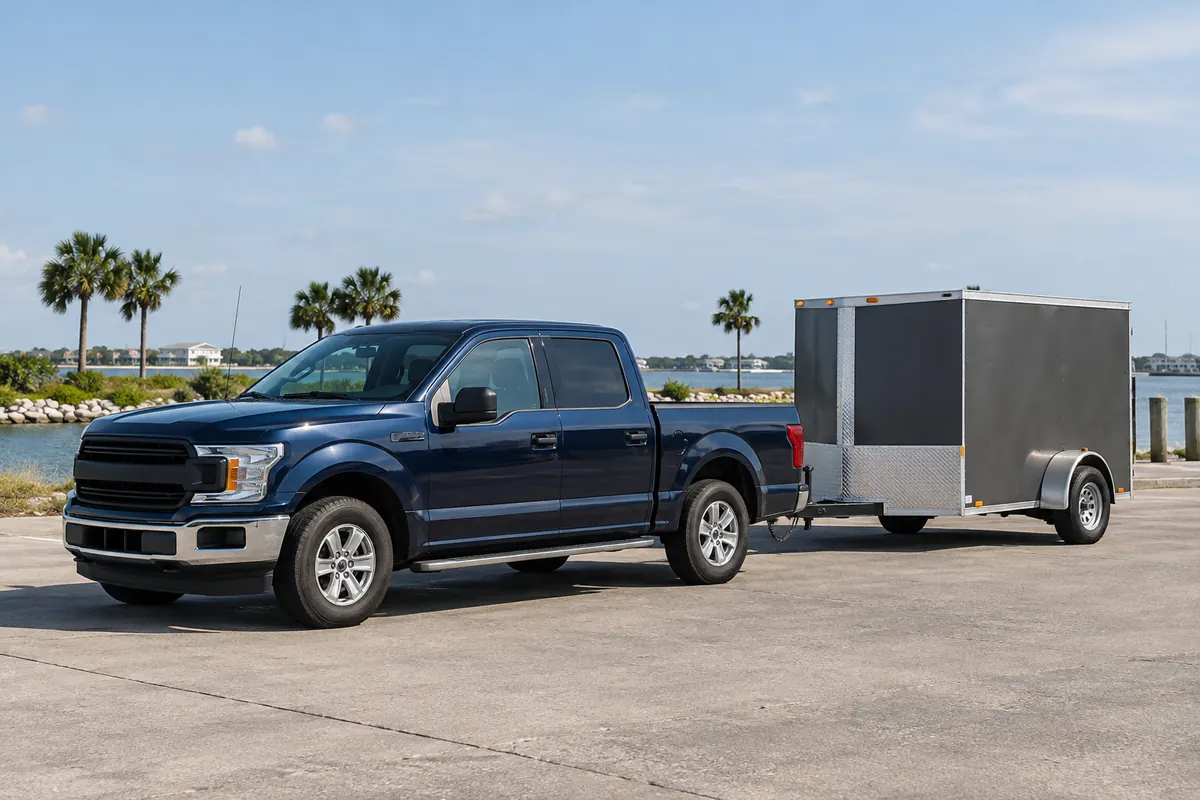
Identify both the disabled vehicle and the trailer
Begin with the towing vehicle’s make, model and relevant configuration, then identify the trailer separately. Describe its actual type, approximate size if known and any reliable specifications available. A utility trailer, enclosed trailer, recreational trailer and equipment trailer create different requests even behind the same truck. State what is uncertain rather than selecting a familiar label that may misrepresent the combination. Explain whether both units are still at the same location.
Provide the trailer’s condition as well as the towing vehicle’s problem. Say whether damage, a wheel issue or another limitation is known on either unit. A running tow vehicle does not establish that its trailer can travel, and an apparently intact trailer does not establish that the disabled vehicle can be moved in an ordinary way. Identify the source of condition information, particularly when a driver, owner and company coordinator are supplying different parts of the request.
Explain the connection as it currently exists
State whether the trailer remains connected and describe the arrangement using information you actually know. Report a visible problem or unavailable key without trying to diagnose the hitch or connection hardware. Tell dispatch if an earlier person has already changed the setup, and distinguish the present state from how the combination was traveling before the breakdown. Existing photographs or documentation may clarify the description, but they do not determine which handling method is suitable.
Do not disconnect the trailer or change supports merely to simplify a towing request. Likewise, do not assume it can be left in place while the towing vehicle departs. That decision involves the actual condition, property access and the service arrangement being reviewed. Explain any proposed change as a question for the responsible parties, not a preparation step already approved by this guide. Keep the driver or knowledgeable contact reachable for clarification about the current configuration.
Describe cargo and use the right weight information
Tell dispatch what the trailer carries and whether the towing vehicle also has relevant cargo or fitted equipment. State the nature of the load and any known condition that affects the request without opening, unloading or disturbing it to investigate. Identify loose or detached items separately when relevant. Do not describe a trailer as empty because you do not know its contents. Ask the responsible owner or company contact for accurate information and keep unanswered questions explicit.
When a weight is available, explain whether it is an actual current measurement, a manufacturer specification or a rating. Those numbers are not interchangeable. Provide dimensions with their source and identify additions that alter the combination’s size. A trailer model or a capacity label does not establish the present loaded weight. If a load includes specialized contents, ask dispatch what additional information is needed before service can be considered. The request should not hide cargo details behind a general vehicle description.
Map the location of the whole combination
Give the pickup address or road location and describe how both units sit within it. Include their orientation, surrounding space, any slope and the usable approach. A trailer may occupy a second parking space, extend into an access route or sit behind the towing vehicle where an ordinary car photograph does not show it. Explain the actual position without attempting to reposition the combination for a better view. On a roadway, report direction and nearby identifiers from a safe location.
For private property, identify the authorized entrance and responsible access contact. Ask about restrictions that apply to the complete request rather than only to the disabled truck. A gate or loading area suitable for one unit may not establish a workable approach for the whole combination. If photographs can be supplied safely, label which unit and direction each view shows. Keep descriptions of observed access separate from a promise that specific equipment can fit or turn.
Decide what needs to reach each destination
Say whether you are asking about movement of the towing vehicle, the trailer or both. Explain the proposed destinations separately, even when you hope to keep the combination together. A repair shop accepting the disabled vehicle has not automatically agreed to receive a loaded trailer. Obtain the receiving contact, address, entrance and actual acceptance for each unit under consideration. If the final arrangement is undecided, tell dispatch which decision is still pending and who can resolve it.
Discuss people, pets and personal travel separately from vehicle transport. Do not infer passenger space from the number of units involved. If a responsible company is arranging another vehicle or a different cargo plan, identify that as a separate proposed arrangement and coordinate the timing directly. Transport should not be treated as cargo handling, storage or onward delivery by implication. Clarify what the service under review includes, and leave unrelated commitments with the responsible business or owner.
Confirm one coordinated scope and report changes
Ask dispatch to review the complete current facts before comparing availability, equipment or a quote. An estimate for a disabled truck alone is not the same request as a truck, attached trailer and specified load with two receiving arrangements. Ask which parts can be confirmed and what remains conditional. Identify the person authorized to approve the agreed service and the person who can answer practical questions at pickup. A submitted form or preferred time does not finalize the arrangement.
Update the existing request if either unit moves, the connection changes, cargo is removed or a destination revises its acceptance. Describe what replaces the previous information and ask for acknowledgment when the change affects scope. Keep the combination’s current condition visible through the handoff rather than assuming the initial description remains correct. At completion, use the agreed receiving-confirmation process for each included unit. Do not treat the arrival of one vehicle as proof that every part of a multi-unit request is finished.