

B’S TOWING • GREATER NEW ORLEANS
Equipment hauling preparation
Prefer a callback? Leave your number.
Dispatch confirms availability, equipment, timing and price. A request is not a confirmed booking.
Equipment transport begins with verified dimensions, operating weight and loading condition.
Start with the important details
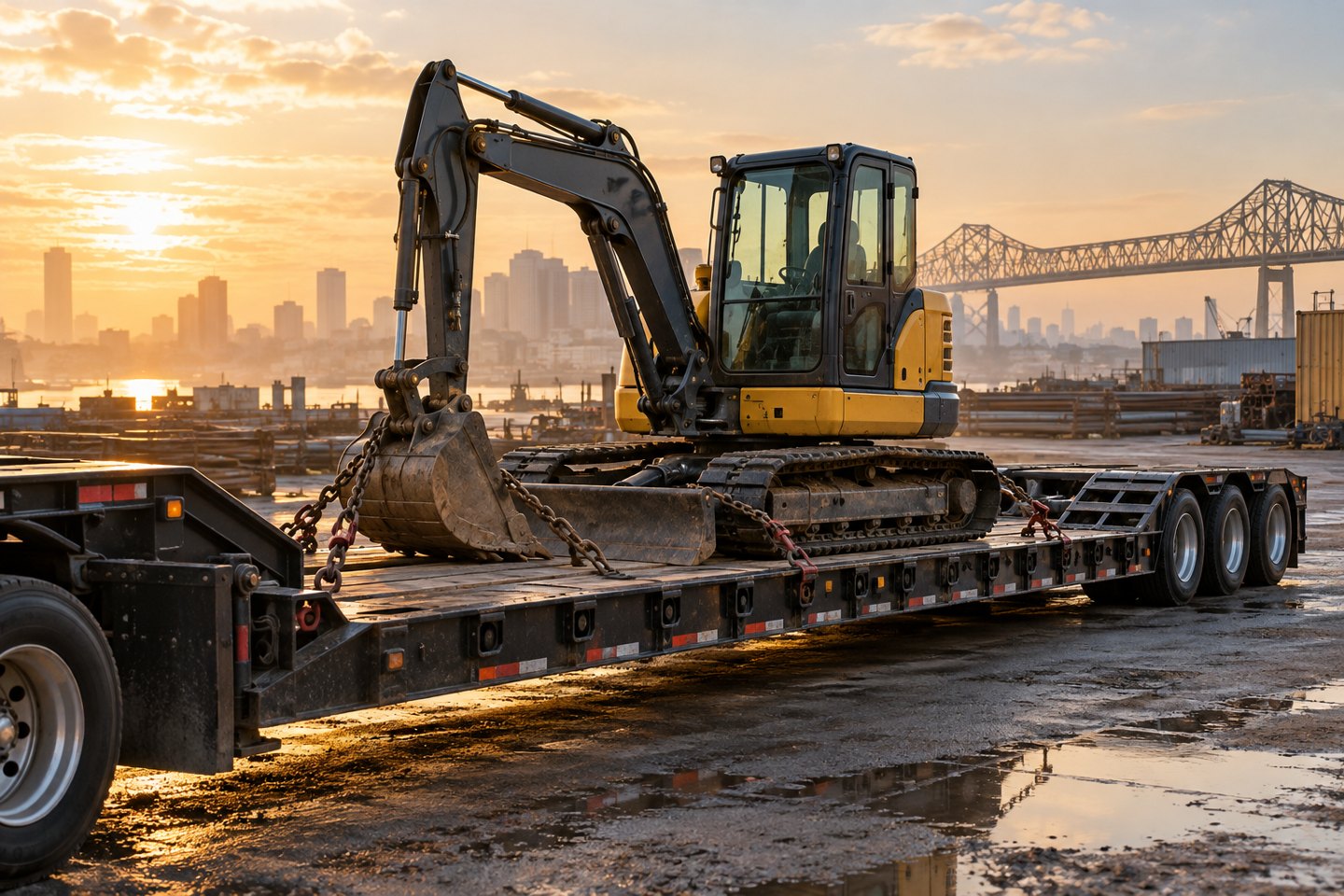
Equipment transport begins with verified dimensions, operating weight and loading condition. A brochure specification may not include attachments, fluids, ballast or a changed configuration. Tell dispatch what is attached, whether the machine operates normally and how the truck can reach the loading area. Operators need the actual pickup and unloading conditions to review capacity and securement. Do not remove or move attachments without appropriate training and authorization. Confirm the transport provider can handle the particular machine before treating a request as booked.
Find your situation
- Compact equipment hauling request
- Skid-steer hauling preparation
- Mini-excavator hauling preparation
- Forklift transport planning
- Generator hauling request
- Nonrunning equipment pickup
- Equipment with missing weight information
- Equipment with oversized attachments
- Jobsite equipment pickup
- Equipment delivery to a narrow site
- Equipment hauling with soft ground
- Equipment pickup with a loading deadline
- Equipment condition photos
- Equipment transport authorization
Compact equipment hauling request
For a compact machine, describe actual dimensions, weight and attachments. Verify the machine’s configured weight rather than guessing.
Skid-steer hauling preparation
A skid-steer inquiry needs the exact machine, installed attachment and any separate items, documented dimensions and current condition. The full guide brings equipment records, authorized access and accepted receiving together.
Skid-steer hauling inquiry: identify the complete equipment package
Mini-excavator hauling preparation
A mini-excavator inquiry needs the actual model, installed attachment package and applicable dimension records. The full guide connects current condition, authorized site access and accepted receiving without prescribing equipment operation.
Mini-excavator transport inquiry: document the machine and site
Forklift transport planning
For a forklift movement, describe weight, mast height and operating condition. Forklifts vary widely in weight and loading requirements.
Generator hauling request
A generator hauling inquiry needs the actual assembly, documented dimensions and weight, confirmed preparation and accepted receiving site. Use the complete guide to separate technical readiness from the transport request.
Nonrunning equipment pickup
Nonrunning equipment needs its exact identity, installed attachments, documented dimensions and separate movement limitations. Review the full guide to coordinate technical readiness, authorized access and an accepted receiver.
Equipment with missing weight information
For a machine without verified weight, describe model plate, configuration and reliable documentation. Do not substitute an unsupported weight estimate.
Equipment with oversized attachments
For a machine with large attachments, describe attachment dimensions and whether they remain installed. Overall dimensions must include the transport configuration.
Jobsite equipment pickup
For a pickup at a worksite, describe site contact, ground condition and access route. Follow the jobsite’s authorized access and safety requirements.
Equipment delivery to a narrow site
For delivery to a constrained work area, describe entrance size, turn space and unloading area. Receiving access must be planned before departure.
Equipment hauling with soft ground
For a pickup on unstable ground, describe surface condition and firm access options. Ground conditions may limit truck positioning.
Equipment pickup with a loading deadline
For a time-sensitive equipment movement, describe release time, loading access and receiving availability. Confirm the actual loading window with all parties.
Equipment condition photos
For documentation of a machine pickup, describe existing damage and configuration photos. Take photos without entering a machine’s operating zone.
Confirm the service and handoff
Before a vehicle or load moves, discuss the equipment, actual pickup access, destination and receiving contact. Ask what the quote covers and which details remain unresolved. A form or text is a request; wait for dispatch to confirm the arrangement.
Read about the related service, review pricing factors, or send your request. For time-sensitive coordination, call dispatch. Contact emergency services first if there is immediate danger or injury.
Your topic-specific dispatch checklist
Use the points that fit the actual situation. Tell dispatch which details are confirmed, and identify any that you cannot safely check. These notes help describe the job; they do not replace manufacturer guidance, emergency services or the operator’s assessment.
- Actual dimensions: give dispatch the current information; say when a detail is unknown.
- Machine model: give dispatch the current information; say when a detail is unknown.
- Dimensions: give dispatch the current information; say when a detail is unknown.
- Weight: give dispatch the current information; say when a detail is unknown.
- Whether it rolls or moves and available loading access: give dispatch the current information; say when a detail is unknown.
- Model plate: give dispatch the current information; say when a detail is unknown.
- Attachment dimensions and whether they remain installed: give dispatch the current information; say when a detail is unknown.
- Site contact: give dispatch the current information; say when a detail is unknown.
- Entrance size: give dispatch the current information; say when a detail is unknown.
- Surface condition and firm access options: give dispatch the current information; say when a detail is unknown.
- Release time: give dispatch the current information; say when a detail is unknown.
- Existing damage and configuration photos: give dispatch the current information; say when a detail is unknown.
- Authorized contact and release instructions: give dispatch the current information; say when a detail is unknown.
Make the receiving arrangement clear
Before loading, confirm who can receive the vehicle or equipment and how the receiving site will be accessed. Share the destination address, contact name, phone number and any gate or after-hours instructions. A repair shop may need to approve the arrival, while a commercial yard may require a specific entrance or unloading space. Tell dispatch if nobody will be present so an authorized handoff can be discussed. Do not assume that a closed business, locked lot or empty job site can accept a delivery simply because an address was supplied.
Build an equipment move brief that a receiver can confirm
Start with an itemized load description when a move includes more than one piece of equipment. Identify each item, its known dimensions and the source of any weight information. Explain which attachments are connected and which are separate. Do not combine several estimates into a supposedly exact total. Dispatch needs to understand the actual items and their configuration before reviewing available transport equipment.
Describe who can provide information at the pickup site. The person booking transport may not be the person who operates or controls the equipment. Identify a site contact who can answer condition and access questions and a person authorized to approve the move. Keep those roles explicit if the equipment belongs to a rental company, contractor or another organization.
Prepare the route into the property, not just the street address. Include gate arrangements, site check-in, loading access and the area where the equipment sits. If the site needs a scheduled access window, explain that before choosing timing. Do not move equipment or alter its configuration to fit an assumed truck without an approved plan.
At the receiving end, confirm the contact and the intended unloading area. Tell the receiver what is arriving and ask which entrance and arrival process should be used. Explain any dependency such as a locked yard or a person needed to operate the equipment. A receiving address is incomplete until someone can accept the item in its expected condition.
Keep the item list, pickup description and receiving instructions together as one version of the request. If an attachment is added, an item becomes inoperable or the destination changes, update that version and notify dispatch. Ask whether the new facts change the equipment plan or quoted scope. The transport conversation should describe the load that will actually be moved, not the load as it appeared in an earlier photo.
More pickup planning
For equipment on an active job site, identify the individual machine, actual configuration, approved entrance, readiness and responsible release contact. Confirm the receiving arrangement and requested scope using current site information.
Equipment pickup from an active job site: prepare the handoff
More pickup planning
Forklift inquiries need the actual machine records, configuration and access, plus responsible contacts at both sites. Separate loose accessories and site work from the requested machine movement.
Forklift transport inquiries: describe the machine, configuration and site handoff
More pickup planning
Tractor planning starts with the actual configuration and included implements. Explain ground access, equipment records and the receiver so dispatch can review one accurate request.
Tractor transport inquiries: clarify implements, records and the receiving site
More pickup planning
Mower planning needs the configured machine and collection route, not just a cutting-width label. Coordinate installed accessories, repair condition and the receiving handoff.
Zero-turn mower hauling inquiries: describe the deck, machine and collection access
More pickup planning
Scissor-lift inquiries need an identified unit, current configuration and a real access plan. Connect equipment approval, site contacts and physical receiving before relying on a move.
Scissor-lift transport inquiries: match machine records with the real site conditions