

B’S TOWING • GREATER NEW ORLEANS
Temporary spare tire: roadside help or towing?
Prefer a callback? Leave your number.
Dispatch confirms availability, equipment, timing and price. A request is not a confirmed booking.
A temporary spare can change a flat-tire request, but its presence alone does not mean the vehicle is ready to drive. The spare must suit the vehicle, be usable, and be fitted under appropriate conditions. The damaged wheel, pickup position and any other symptoms also matter. When you contact B’s Towing, say whether you have a compact spare, a full-size spare, or only an inflator kit. If you have not checked, simply say that the spare is unconfirmed.
On this page
- A spare in the trunk does not settle the service decision
- Read the restrictions for your actual spare
- Describe the spare’s condition and availability
- Explain what happened to the original wheel
- The working space matters as much as the spare
- Plan the destination before committing to a short-term solution
- Keep the conversation short and complete
- Questions and answers
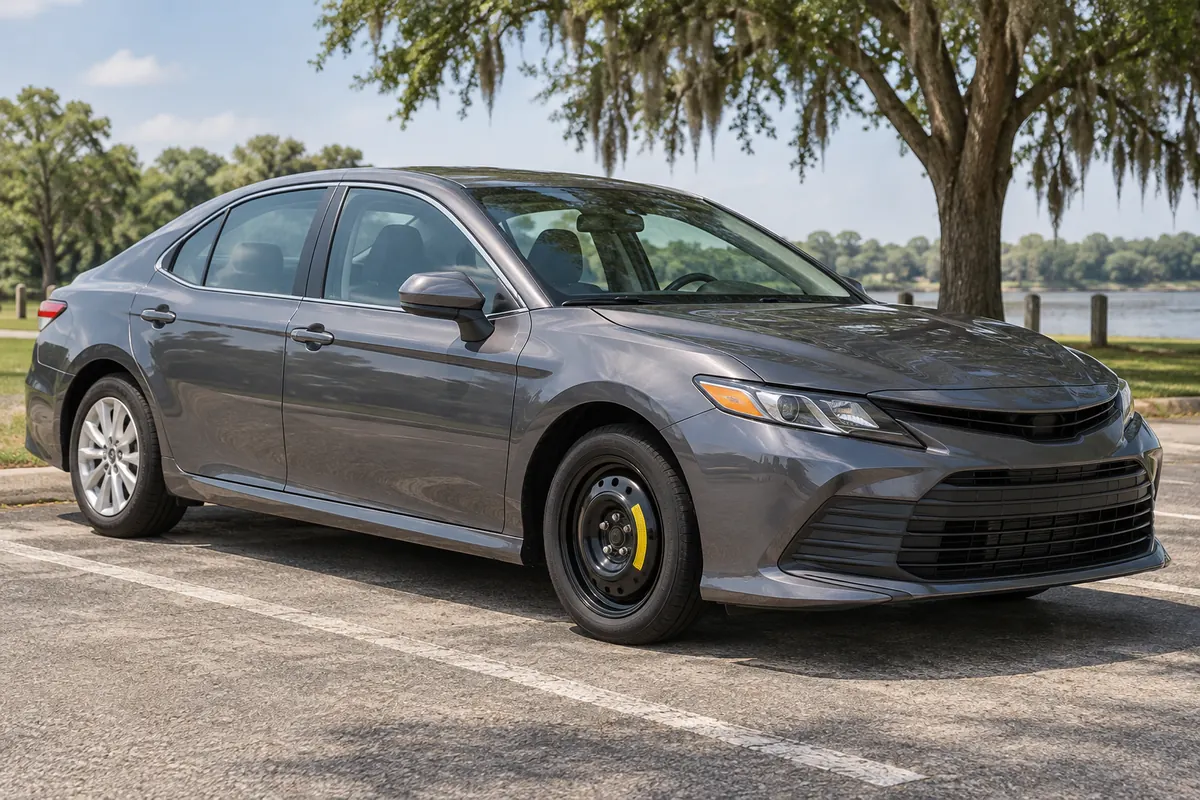
A spare in the trunk does not settle the service decision
This guide helps you describe a temporary-spare situation and decide what to discuss with dispatch. It is not a tire-changing procedure or approval to drive on a particular spare. The vehicle manual and the spare’s markings provide the applicable limits. If a roadside solution cannot be confirmed, discuss transport to a tire or repair destination instead of assuming the spare will complete the trip.
Read the restrictions for your actual spare
Compact temporary spares can have limits on speed, distance, pressure and use that differ from the vehicle’s regular tires. Do not apply a number remembered from another car. Look at the instructions for your vehicle and the markings on the actual spare when those can be checked safely. Michelin’s spare-tire guidance explains that restrictions vary. A temporary spare is a short-term arrangement, rather than a replacement for completing the tire repair.
Tell dispatch if the instructions are missing or the markings cannot be read. You do not need to crawl under a vehicle or stand beside moving traffic to find them. An unreadable limit is an unresolved detail, not permission to use a generic maximum. If your destination requires a long trip, mention that before choosing between a roadside request and transport. The nearest convenient address may not be a suitable repair destination.
Describe the spare’s condition and availability
A spare can be inaccessible, visibly damaged, deflated, missing, or locked into a carrier. Explain what you already know about its condition. Tell dispatch whether the wheel-lock key and vehicle key are available, and whether luggage or equipment blocks access. Do not describe a spare as ready merely because you remember seeing it months ago. The tire and vehicle still need an appropriate assessment at the time of service.
Some vehicles have an inflator or sealant kit instead of a spare. These are different arrangements. If you only see a compressor and sealant bottle, identify that accurately rather than choosing the spare-tire option by guesswork. A mobility kit cannot be assumed to resolve every kind of tire damage. Tell dispatch about a torn tire, impact, or visible wheel damage so the request is not based on the wrong equipment.
Explain what happened to the original wheel
An ordinary puncture and an impact against a pothole can lead to different pickup needs. Share which tire is affected, whether the wheel looks bent, and whether steering, vibration or unusual noises occurred before stopping. Report observations without attempting to diagnose the suspension. If another tire is also damaged, say so immediately: fitting one spare does not settle a two-tire problem.
If the vehicle was driven after losing pressure, include that history. A photograph from a safe standing position can help show the visible condition, but it cannot establish the tire’s internal condition. Tire repairability belongs with a qualified tire professional. A roadside request should therefore focus on what can be assessed and arranged now, while the receiving shop handles the repair decision.
The working space matters as much as the spare
Give the exact pickup point and explain the surroundings: garage level, parking-space orientation, narrow shoulder, steep driveway, or restricted entrance. A spare that could be fitted in a suitable work area does not make every roadside position suitable. Do not move the vehicle, place a jack, or enter traffic merely to simplify the request. Dispatch needs an accurate access description before confirming the service plan.
Use a location pin together with written directions to the actual entrance. At a shopping center, the street address may lead to a different side of the property. In a garage, identify the level and posted clearance if already visible. Tell dispatch about gates or an attendant who controls entry. These details help distinguish a straightforward access arrangement from one that needs a different approach.
Plan the destination before committing to a short-term solution
If a temporary spare is being considered, discuss where the vehicle would go next and whether the receiving tire shop can accept it. A shop’s online hours do not establish that it has the tire, space or appointment you need. Contact the receiver to confirm the arrangement. Share the destination with dispatch if transport may be needed, including after-hours instructions and a reachable receiving contact.
Ask what the proposed roadside service includes and what happens if the spare is unsuitable. Do not assume a tow is automatically included in a tire-service quote. Equipment, access and the actual condition can change the scope. B’s Towing dispatch can review availability and the proposed arrangement, but an online form is a request for coordination rather than a confirmed truck assignment.
Keep the conversation short and complete
A useful opening message is: temporary spare available or unconfirmed; affected wheel; vehicle year, make and model; exact location; and a callback number. Add any visible wheel damage and the intended destination. Mention whether you have children, pets or mobility needs so passenger arrangements can be discussed separately. Do not assume everyone can ride in the service vehicle.
Call 504-908-0072 when prompt coordination is needed, or text the same number with your pickup details. If you prefer a form, send the service request and remain reachable for clarification. Update the existing request if the car’s location or condition changes. Repeated separate requests with different details can make an otherwise simple pickup harder to coordinate.
Questions about this situation
Further guidance
Vehicle instructions and an appropriate professional assessment govern the actual service. Source guidance reviewed October 2026.