

B’S TOWING • GREATER NEW ORLEANS
Tire sidewall damage: arrange help without guessing at repairability
Prefer a callback? Leave your number.
Dispatch confirms availability, equipment, timing and price. A request is not a confirmed booking.
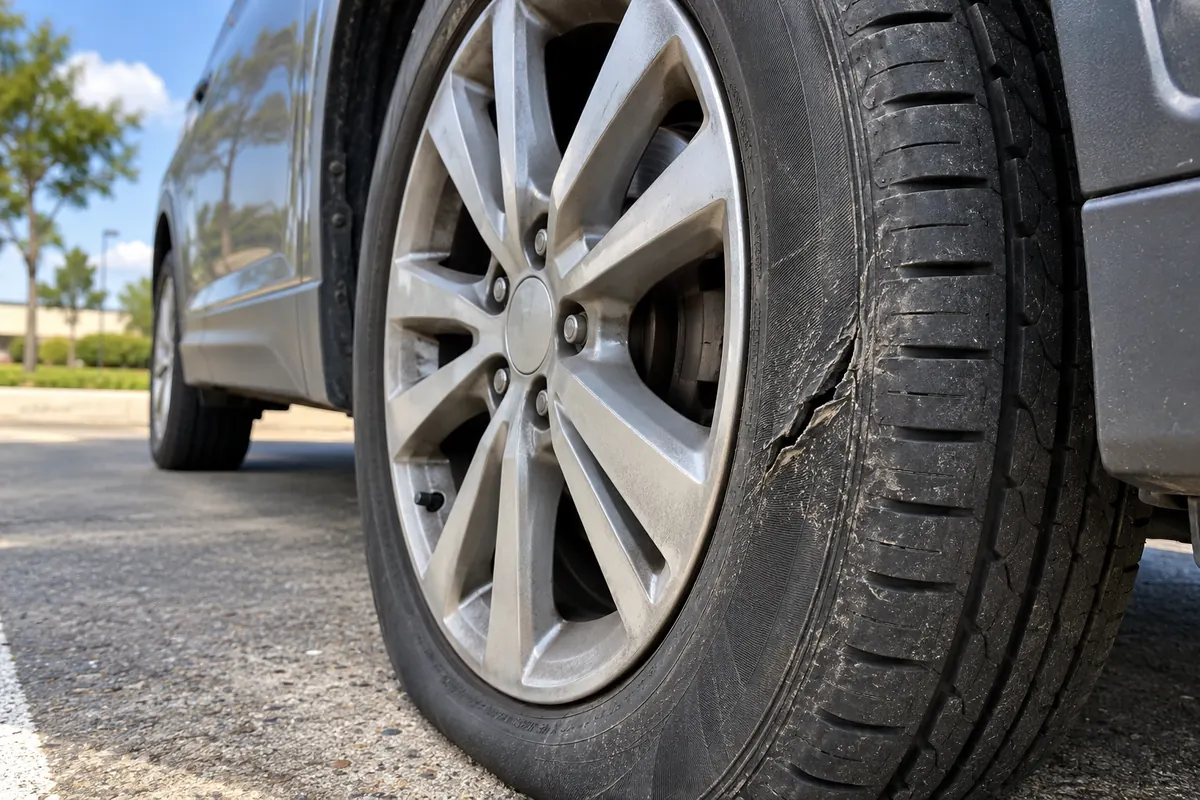
A cut, bulge or tear on the side of a tire should not be described simply as a small puncture. Tell dispatch that the visible problem is on the sidewall and identify the wheel when you can do so safely. Explain whether the tire lost air, whether there was an impact, and whether a usable spare is available. Those details help frame the request without assuming an ordinary puncture repair will solve it.
On this page
- A sidewall problem needs a different conversation
- Describe a bulge, cut and scrape accurately
- Why a sidewall complaint should not be booked as a simple plug
- Share the impact and driving history
- Spare status changes the available options
- Show the access constraints and receiving plan
- Approve a clear service scope
- Questions and answers
A sidewall problem needs a different conversation
B’s Towing can review the roadside or transport arrangement with you. A tire professional determines the tire’s condition and repairability. This page is a guide to requesting service, rather than a repair procedure or clearance to keep driving. Do not attempt to prove that a damaged tire holds pressure by driving, overinflating it or carrying out an improvised repair.
Describe a bulge, cut and scrape accurately
Use plain observations: an outward bubble, a visible cut, a torn section, or a mark whose depth you cannot tell. Mention any exposed material, loss of air or contact with the rim that you already see. You do not need to decide whether internal cords have failed. A description of the shape and location is more helpful than a confident diagnosis based on an internet photograph.
A superficial-looking mark and deeper structural damage are not interchangeable, but a phone conversation cannot settle that distinction for every tire. If you are unsure, say so. Photographs can help show the visible area from a safe position, yet the inside of a tire and the full impact history may require professional inspection. Do not let an incomplete picture become a promise that the vehicle is safe to move.
Why a sidewall complaint should not be booked as a simple plug
Tire repair guidance distinguishes repairable tread-area damage from sidewall damage. Michelin’s consumer guidance identifies sidewall damage as a replacement situation rather than a routine puncture repair. That is why the important question for dispatch is how to arrange help for the vehicle, not which roadside sealant or plug to request. Do not assume a mobility kit is suitable for a torn sidewall or blowout.
Tell dispatch whether the vehicle carries a real spare or only an inflator kit. If a spare is available, its condition and the vehicle’s instructions still matter. A temporary spare may have specific restrictions, and the working area must be suitable. If those details cannot be confirmed, discuss transport to a tire or repair destination rather than expecting roadside work to establish the final repair.
Spare status changes the available options
If you have a spare, describe whether it is compact or full size and whether its condition is known. Mention missing tools or a missing wheel-lock key. Say if luggage, cargo, a carrier or a locked compartment prevents access. Dispatch can review the service request using those facts, rather than assuming a complete tire-change setup is already ready beside the vehicle.
If there is no usable spare, make that clear at the beginning. Do not expect a roadside service vehicle to carry the correct replacement tire for every model. Ask what service is actually available for your location and vehicle. A transport arrangement may be the practical next step, but equipment, destination and access still require confirmation before the request becomes a booking.
Show the access constraints and receiving plan
Provide the actual pickup point, entrance and parking position. A sidewall problem inside a low garage, against a wall or beside fast-moving traffic can require a different plan from an open parking lot. If you already know that the vehicle cannot roll or steer, say so. Do not move it to demonstrate the fault or expose yourself to traffic while gathering details.
Choose a receiving destination that has agreed to accept the vehicle. Ask about tire availability and unloading instructions directly with the shop; do not assume dispatch can promise a repair appointment. If the receiver is closed, confirm after-hours acceptance and key arrangements before supplying that address. Describe unloading access too, especially where the vehicle will still have a damaged wheel at delivery.
Approve a clear service scope
Give dispatch your vehicle year, make and model, callback number, damaged wheel, spare status, pickup and proposed destination. Ask whether the proposed arrangement is roadside assessment, a tire change using an appropriate spare, transport, or another confirmed service. Clarify what the quote covers and what would change if additional wheel or access problems are found.
Call or text B’s Towing at 504-908-0072 when you need to coordinate the next step. The request form is another option if you can remain reachable. Passenger transportation should be discussed separately, particularly with children, pets or mobility needs. Wait for dispatch confirmation; sending a photo or submitting a form does not assign a truck or establish a tire’s condition.
Questions about this situation
Further guidance
Vehicle instructions and an appropriate professional assessment govern the actual service. Source guidance reviewed October 2026.